1
/
of
4
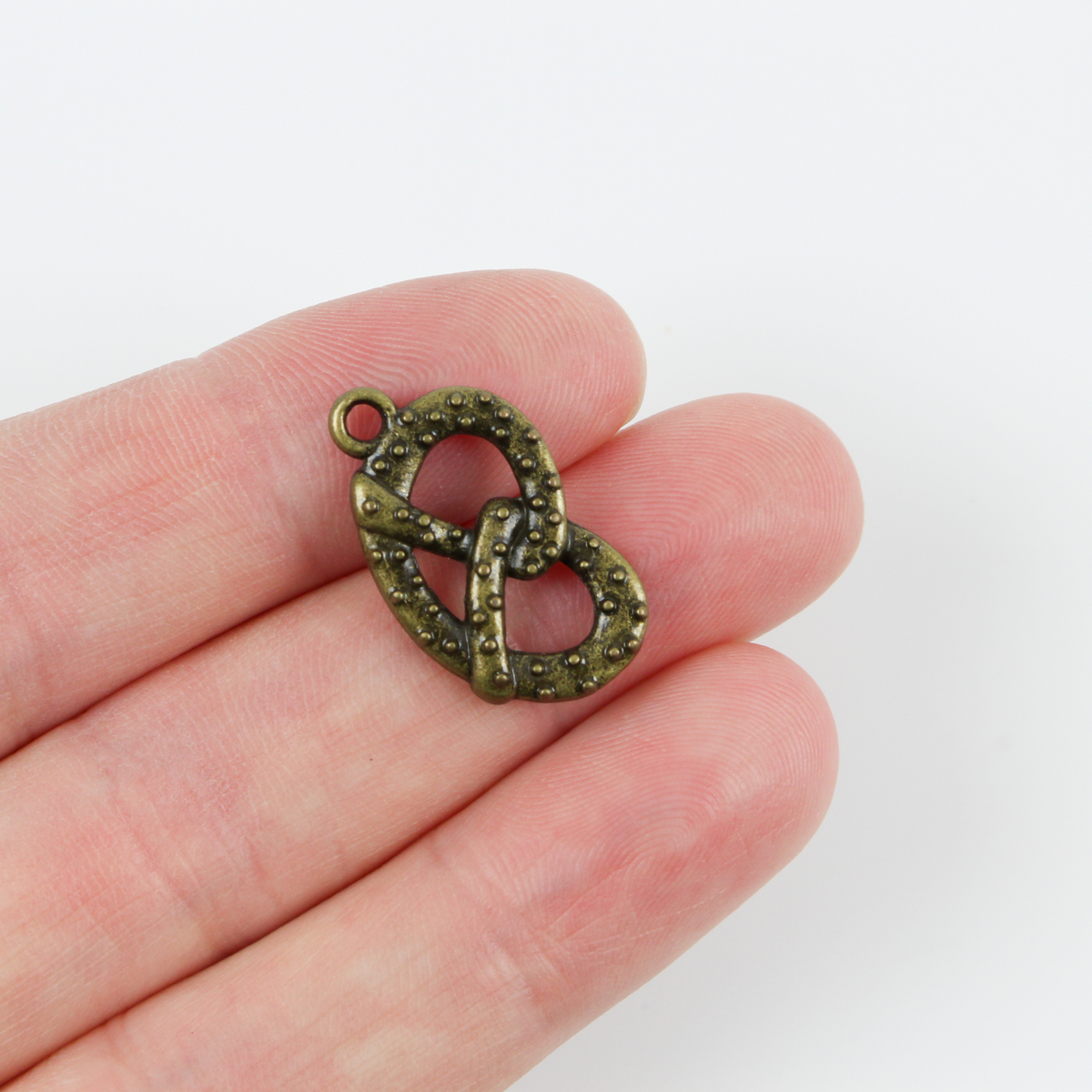
Bronze Pretzel Charms - Symbol of Prosperity, Undying Love, and Spiritual Fulfillment 22mm long - 3pcs
Bronze Pretzel Charms - Symbol of Prosperity, Undying Love, and Spiritual Fulfillment 22mm long - 3pcs
SKU:BC38A
Regular price
$1.30 USD
Regular price
Sale price
$1.30 USD
Shipping calculated at checkout.
Quantity
Couldn't load pickup availability
Small bronze pretzel charm, sold in sets of three. This is a double-sided charm and looks the same on both sides.
Quantity: Sold in increments of 3
Size: about 22mm long, 13mm wide, 2.5mm thick, the hole is: 2mm
(7/8" long x 1/2" wide)
Material: Zinc alloy with antiqued bronze finish
Symbolism: good luck, prosperity, and spiritual fulfillment, pretzels were also commonly distributed to the poor, as a way of providing them with both spiritual and literal sustenance. By the 17th century, the interlocking loops of the pretzel had come to symbolize undying love as well.
History: The origins of the pretzel go back to a monastery in the mountains between Southern France and Northern Italy. In 610 AD the monks created the first soft pretzels. They didn't want to waste the dough leftover from making unleavened communion bread. Christians in those days prayed with their arms crossed over their chest, with each hand on the opposite shoulder. The monks realized that the dough could be twisted into a similar shape. The treats were given to children as a reward for memorizing their verses and prayers. They were also used to help children understand the Christian Trinity of Father, Son and Holy Ghost. The three empty holes in the pretzel represented the Christian Trinity. The monks called their treats Pretiols, a Latin word that means "Little reward".
The success of the Pretiols spread to monasteries throughout the French and Italian wine regions and crossed over the Alps to Austria and Germany, where they became known as the bretzel, or pretzel. The pretzel became an important symbol in church life. A page from a prayer book of Catherine of Cleves depicts St. Bartholomew surrounded by pretzels, which were thought to bring good fortune, prosperity, and spiritual wholeness to those who ate them. Pretzels were a convenient way to give food to the poor and became typical alms for the hungry. Those who gave pretzels away were considered particularly blessed. They became such a sacred symbol that they were often packed into coffins.
Legend has it that in 1614 in Switzerland, royal couples used a pretzel in their wedding ceremonies (similar to how a wishbone might be used today) to seal the bond of matrimony and that this custom may have been the origin of the phrase “tying the knot.”
Quantity: Sold in increments of 3
Size: about 22mm long, 13mm wide, 2.5mm thick, the hole is: 2mm
(7/8" long x 1/2" wide)
Material: Zinc alloy with antiqued bronze finish
Symbolism: good luck, prosperity, and spiritual fulfillment, pretzels were also commonly distributed to the poor, as a way of providing them with both spiritual and literal sustenance. By the 17th century, the interlocking loops of the pretzel had come to symbolize undying love as well.
History: The origins of the pretzel go back to a monastery in the mountains between Southern France and Northern Italy. In 610 AD the monks created the first soft pretzels. They didn't want to waste the dough leftover from making unleavened communion bread. Christians in those days prayed with their arms crossed over their chest, with each hand on the opposite shoulder. The monks realized that the dough could be twisted into a similar shape. The treats were given to children as a reward for memorizing their verses and prayers. They were also used to help children understand the Christian Trinity of Father, Son and Holy Ghost. The three empty holes in the pretzel represented the Christian Trinity. The monks called their treats Pretiols, a Latin word that means "Little reward".
The success of the Pretiols spread to monasteries throughout the French and Italian wine regions and crossed over the Alps to Austria and Germany, where they became known as the bretzel, or pretzel. The pretzel became an important symbol in church life. A page from a prayer book of Catherine of Cleves depicts St. Bartholomew surrounded by pretzels, which were thought to bring good fortune, prosperity, and spiritual wholeness to those who ate them. Pretzels were a convenient way to give food to the poor and became typical alms for the hungry. Those who gave pretzels away were considered particularly blessed. They became such a sacred symbol that they were often packed into coffins.
Legend has it that in 1614 in Switzerland, royal couples used a pretzel in their wedding ceremonies (similar to how a wishbone might be used today) to seal the bond of matrimony and that this custom may have been the origin of the phrase “tying the knot.”
Share